
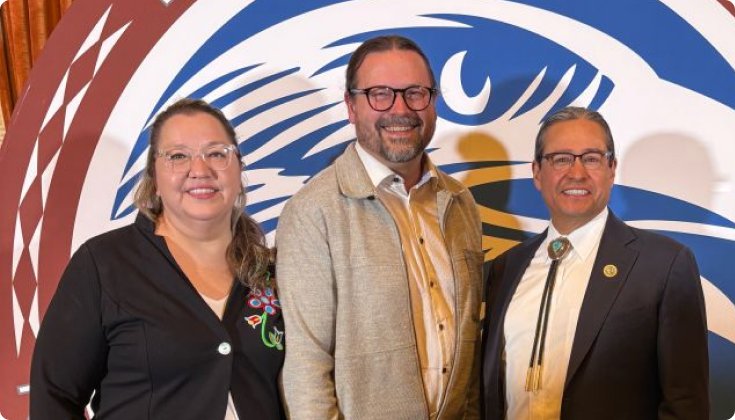
Macpherson Law LLP has been attending this year’s Res conference in Las Vegas which hosts First Nations Chiefs from both sides of the Canada -US border.
Pictured to my left is National Chief Cindy Woodhouse Nepinak, and to my right Mark Macarro, President of the National Congress of American Indians (NCAI).
The two advocacy organizations renewed their Declaration of Kinship and Co-operation among Indigenous Peoples and Nations of North America at the National Center for American Indian Enterprise Development’s Reservation Economic Summit. The agreement was first signed in 1999 in Vancouver.
Here are a few quotes from yesterday’s press conference which I attended:
“Canada and the U.S. can fight all they want, but First Nations people on both sides of the border, we’re going to stick together strongly.”
“We’re going to continue to find our trade routes and push for tariff-free zones.” -Cindy Woodhouse Nepinak
“Though borders were imposed upon our homelands, the relationships among our peoples never ceased.”
“By renewing this declaration with the Assembly of First Nations, we reaffirm that our voices are strongest when we stand together in mutual respect, solidarity, and collective purpose.” -Mark Macarro
To my mind, these quotations and yesterday’s discussion echoed what I heard last week at Michael Binnion’s Azuridge conference in Pridis Alberta. Azuridge attracts some of North America’s leading energy thought leaders. Among the speakers was MIT educated Vikram Mansharamani who I’ve started to get to know and who has a remarkable ability to cut through political rhetoric and see the emerging economic trade patterns ahead. One of his observations was that we are going to see much more north to south trade patterns as opposed to historical east to west trade patterns.
As Cindy and Mark reminded us yesterday, while the Canada – US border is a recent colonial construct – an imaginary line to North America’s first peoples who have lived on the continent since the sheets of ice receded on Turtle Island.
My own read is that the colonial construct of borders (for mobility, trade, residency and tax) for First Nations peoples will over time fade. This will provide North America’s first peoples with many additional economic blessings and advantages in the years to come such as tariff free trade routes.